
St. Landry Parish Court Records After a Jail Arrest
After a St. Landry Parish arrest, jail booking is usually the first public signal, but it is not the same thing as the criminal court record. The St. Landry Parish Jail is operated by the St. Landry Parish Sheriff's Office, and the inspected LAVNS roster showed a current-custody list with name, date of birth, race, gender, and an arrest-date column. The formal court records after a jail arrest are kept through the St. Landry Parish Clerk of Court's Courts Division for the 27th Judicial District and related local court matters.
The District Attorney, Chad Pitre, reviews arrest information and decides whether charges should be filed, amended, rejected, dismissed, diverted, or later added. That means the offense description associated with an arrest can differ from the charges that appear later in court records. For custody status, use jail inmate records. For booking-photo issues, use jail mugshots. For filed charges and court activity after an arrest, the main local record channels are the Clerk of Court, ClerkConnect, the DA's office, and the appropriate court division.
The St. Landry Parish Clerk describes its Court Division as the custodian for records of criminal proceedings. The clerk also reports that indexes to civil and criminal suits are available from the beginning of the parish, with document images in case files from 1997 forward, except confidential matters such as juvenile and adoption records. That distinction matters because a jail arrest is public-facing custody information, while the court file is the record that tracks what prosecutors and judges do with the case.
How to Find Court Records After an Arrest
The local online court-record channel is ClerkConnect, which the St. Landry Parish Clerk identifies for criminal, traffic, civil, probate, and family records. Online searching is subscription-based. The research captured ClerkConnect access costs of $20 for one day, $50 for 30 days, and $600 for 365 days, with a $1.00 per printed page fee. The search fields inside the paid portal were not visible before registration, so name and case-number search options should be confirmed inside ClerkConnect rather than assumed from a public preview.
- Confirm current custody first on the St. Landry LAVNS roster if the arrest is recent.
- Open the St. Landry Clerk's ClerkConnect registration page and choose the access period that fits the search need.
- Search inside the subscribed court-record system using the identifiers the portal makes available, such as the defendant name or case number if known.
- Review the criminal or traffic case for the filed charges, minute entries, hearings, bond decisions, amendments, dismissals, and disposition fields that are available.
- If the online record is not enough, contact the Clerk of Court at 118 South Court Street, Suite 207, Opelousas, LA 70570, main phone 337-942-5606, Courts Division extension 5113.
The St. Landry Clerk's court overview explains where criminal records are kept and how court files are organized. Source: St. Landry Parish Clerk of Court courts overview.
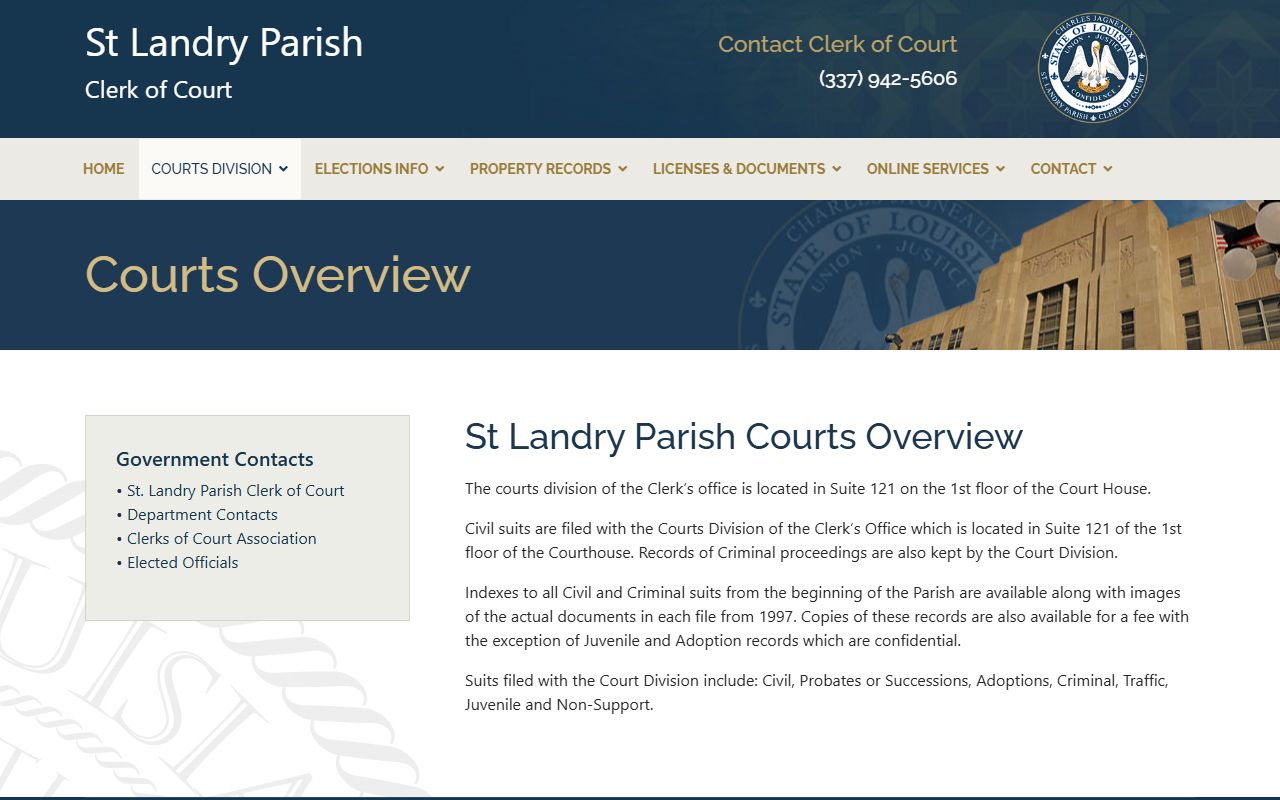
The clerk source supports the split between jail custody records and court records after arrest, because the court division keeps the filed criminal proceeding while the sheriff roster shows only current jail status.
Louisiana law also adds a statewide electronic-access layer. Louisiana R.S. 13:5992 created a Truth and Transparency criminal minute-entry access program for criminal court matters filed on or after January 1, 2020. The statute identifies minute-entry or summary content such as arrest or summons information, custody and bail decisions, filing, amendment, or dismissal of charges, hearings, judge identity, prosecutor identity, sentencing, and defendant identity. Use that statute as a court-record access anchor, not as a promise that every document image is free or instantly available.
ClerkConnect Features and Costs
ClerkConnect is important for court records after a St. Landry Parish arrest because it is the clerk's published online access path for criminal and traffic records. The public registration page documents the subscription options, but it does not expose all search fields before registration. Treat ClerkConnect as the paid court index and case-access system, then use the clerk's office for copies, certified records, or questions about records that do not appear online.
| ClerkConnect Item | Documented Detail | Practical Use |
|---|---|---|
| Record types | Criminal, traffic, civil, probate, and family records | Use the criminal or traffic side for charges after an arrest. |
| One-day access | $20 daily subscription | Useful for a narrow lookup when the case identifier is known. |
| Monthly access | $50 for 30 days | Useful when checking for later filings, amendments, or disposition updates. |
| Annual access | $600 for 365 days | More practical for frequent public-record users. |
| Printed pages | $1.00 per printed page | Budget for copy costs when printing case documents. |
The subscription source for St. Landry court records is the clerk's ClerkConnect registration page. Source: St. Landry ClerkConnect registration.
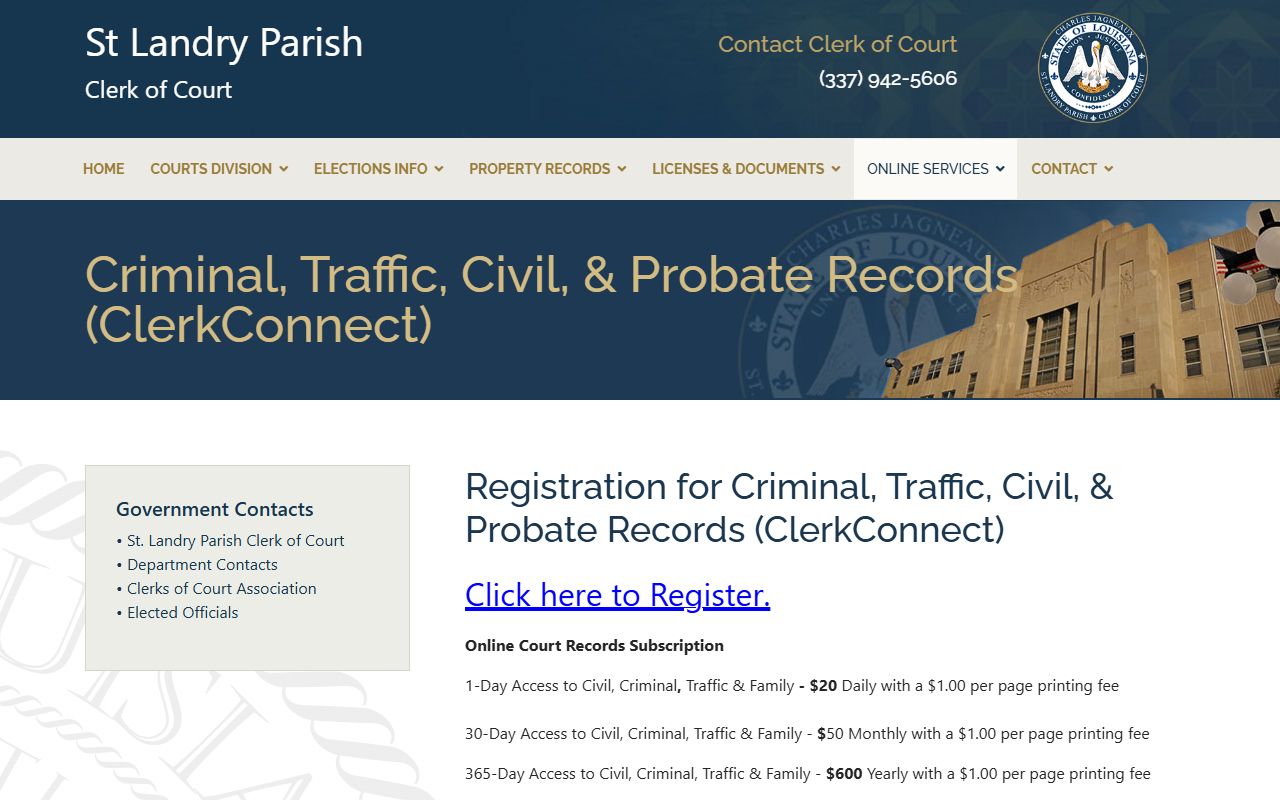
The fee table matters for arrest-related court records because the St. Landry jail roster is free but limited, while ClerkConnect is the paid route for the filed case record.
How Charges Get Filed After an Arrest: Complaint, Information, and Indictment
Louisiana Code of Criminal Procedure art. 228 is the booking-record anchor. It requires booking entries or summaries to include identifying information, property taken, date and time, charges, arresting person, and short facts, and it provides that booking books and summaries are open for public inspection. That booking record can exist before the prosecutor finishes a formal charging decision. Once the DA acts, the court case may proceed through a complaint, bill of information, indictment, amendment, dismissal, or other filing.
| Complaint | Information | Indictment | |
|---|---|---|---|
| Filed By | Law-enforcement officer or prosecutor, depending on the matter | Prosecutor | Grand jury |
| Common For | Early or lower-level criminal allegations | Many felony and misdemeanor prosecutions | Serious felony matters requiring grand-jury action |
| Starts | A criminal accusation or case path | The formal prosecution in court | The formal prosecution in court |
Louisiana art. 701 supplies important charging deadlines when a defendant remains in custody after arrest: 30 days for misdemeanors, 60 days for felonies, and 120 days for capital or life-punishment felonies. If the defendant is not continued in custody, the filing periods are longer, including 90 days for misdemeanors and 150 days for felonies. Court records after a jail arrest should therefore be checked again after the initial booking if no filed case appears immediately.
Charge Status in Court Records After Arrest
Charge status changes as the case moves. The booking charge on a jail record may be only the arresting agency's early description. The DA may file a different charge, reduce a charge, add counts, reject a charge, dismiss a count, or enter a nolle prosequi. Minute entries, charging documents, and later dispositions should be read together because a single arrest can create several charges with different statuses.
| Status | What It Means |
|---|---|
| Pending | The charge has not reached final disposition. Hearings, bond conditions, motions, or plea negotiations may still be active. |
| Amended / Reduced | The prosecutor or court changed the charge, or a lesser charge replaced the original allegation. |
| Dismissed | The charge is no longer proceeding in that case, though the reason and effect depend on the court entry. |
| Nolle Prosequi | The prosecutor declined or dropped prosecution on that charge, subject to the legal effect of the entry. |
| Convicted | The charge resulted in an adjudication of guilt by plea or verdict. |
Bond and Release After an Arrest
St. Landry sheriff pages did not publish a complete local bond-payment procedure, accepted payment method list, bond-desk schedule, or online bond portal. The cautious local step is to confirm release eligibility, bond amount, and payment channel with the jail at 337-948-5804 or the proper court before attempting to post money. Louisiana art. 230.1 requires prompt presentation before a judge for appointment of counsel within 72 hours from arrest, excluding Saturdays, Sundays, and legal holidays. That early court event is often where bond and release conditions become clearer.
| Bond Type | How It Works |
|---|---|
| Commercial Surety | A licensed bail agent or surety posts the bail obligation allowed by Louisiana law. |
| Secured Personal Surety | A personal surety backs the bond with security approved through the court process. |
| Unsecured Personal Surety | A personal surety obligation may be accepted without upfront security if the court allows it. |
| Bail Without Surety | Often described in plain language as own-recognizance or PR-style release, subject to conditions set by the court. |
| Cash Deposit | Cash bail may be deposited through the authorized channel, but St. Landry local payment routing should be confirmed first. |
| No-Bond Hold | The person is not eligible for release on a payable bond at that moment, or another hold blocks release. |
A person may remain in St. Landry Parish Jail even when one case appears bondable. Other agency holds, bench warrants, probation or parole matters, DOC transfer issues, federal detainers, or immigration holds can affect release. The inspected St. Landry roster did not show bond or hold fields, so custody confirmation should not rely on the roster alone.
Warrants That Lead to an Arrest
No official St. Landry Parish Sheriff's active-warrant search was located on the sheriff website during the research pass. A warrant arrest may appear on the jail roster after booking, but the inspected list view did not show charges or warrant numbers. For warrant routing, use the sheriff main phone at 337-948-6516, the jail phone for current custody at 337-948-5804, the clerk for court case activity, or ClerkConnect for paid criminal and traffic records. Bench warrants may come from district or city court failures to appear and may not be visible through any sheriff web lookup.
Common warrant terms include arrest warrant, bench warrant, search warrant, fugitive warrant, and probation or parole warrant. A person booked in Opelousas may be physically held in the St. Landry Parish Jail while the legal authority for custody belongs to another court or agency. That is why court records after an arrest should be checked against the custody source and any available warrant or hold information.
Charges vs. Convictions
An arrest and a charge are accusations, not proof that the person was convicted. A conviction requires a guilty plea, verdict, or other adjudication of guilt in court. Court records after a jail arrest may show pending charges for weeks or months before a disposition appears, and individual counts in the same case may end in different ways.
| Charge | Conviction | |
|---|---|---|
| Stage | Accusation after arrest or prosecution filing | Final adjudication by plea, verdict, or court finding |
| Proof Level | Early stages may involve probable cause or filing review | Criminal conviction requires proof beyond a reasonable doubt or a valid plea |
| Public Record | Often public unless a confidentiality rule applies | Often public unless sealed, expunged, juvenile, or otherwise restricted |
Sealed vs. Expunged Arrest Records
Louisiana public-records law starts with broad access under La. R.S. 44:31, but criminal records can be limited by confidentiality rules, juvenile restrictions, sealed records, expungement orders, and specific statutes. The St. Landry Clerk's own court overview notes that juvenile and adoption records are confidential. Expungement is a court process, not a same-day roster correction. Louisiana Code of Criminal Procedure art. 983 also addresses expungement costs and fees, so a person seeking to limit public access should use the proper court process and legal advice when needed.
| Sealed | Expunged | |
|---|---|---|
| Visibility | Hidden or restricted from ordinary public access by court rule or order | Public access is limited through an expungement order under Louisiana procedure |
| Agency Access | Some justice agencies may retain limited lawful access | Some agencies may still have access where Louisiana law allows it |
| Eligibility | Depends on record type, age, offense, and court order | Depends on the case result, offense category, waiting period, and statutory limits |
Background Check Considerations
Casual public-record searching is different from a regulated background check for credit, employment, insurance, housing, tenant screening, or similar decisions. Court records after a jail arrest may be incomplete, may have changed after the last lookup, or may contain charges that never resulted in conviction. For any regulated decision, use a legally compliant screening process and verify records with the originating court or agency.
Important: St. Landry Parish Inmate Population is not a consumer reporting agency under the Fair Credit Reporting Act, and its information cannot be used for FCRA-covered decisions.
Restricted Court Records After an Arrest in St. Landry Parish
Not every arrest-related record is public in full. Juvenile records, adoption matters, sealed filings, expunged records, protected victim information, records tied to active investigations, and certain confidential documents may be restricted. Louisiana public-records statutes, including La. R.S. 44:1, 44:31, and 44:32, establish public-record access and custodian duties, but they also operate alongside legal exceptions. For official booking records not shown on the roster, the sheriff's public-information route is pir@slpsheriff.com. For filed criminal court records, the Clerk of Court and ClerkConnect are the more direct channels.
For prosecution routing, the St. Landry Parish District Attorney's Office is at 231 S. Union Street, Opelousas, LA 70570. The office lists hours of 8:30 a.m. to 4:30 p.m. Monday through Friday, administration at 337-948-3041, felony at 337-948-0551, traffic at 337-948-0531, and support enforcement at 337-942-5719. The DA's role is prosecution and case review; the clerk is the court-record custodian.
Public Record Search
Sponsored Results